
For years, the biggest question in Canadian immigration was simple: Were the numbers going up or down?
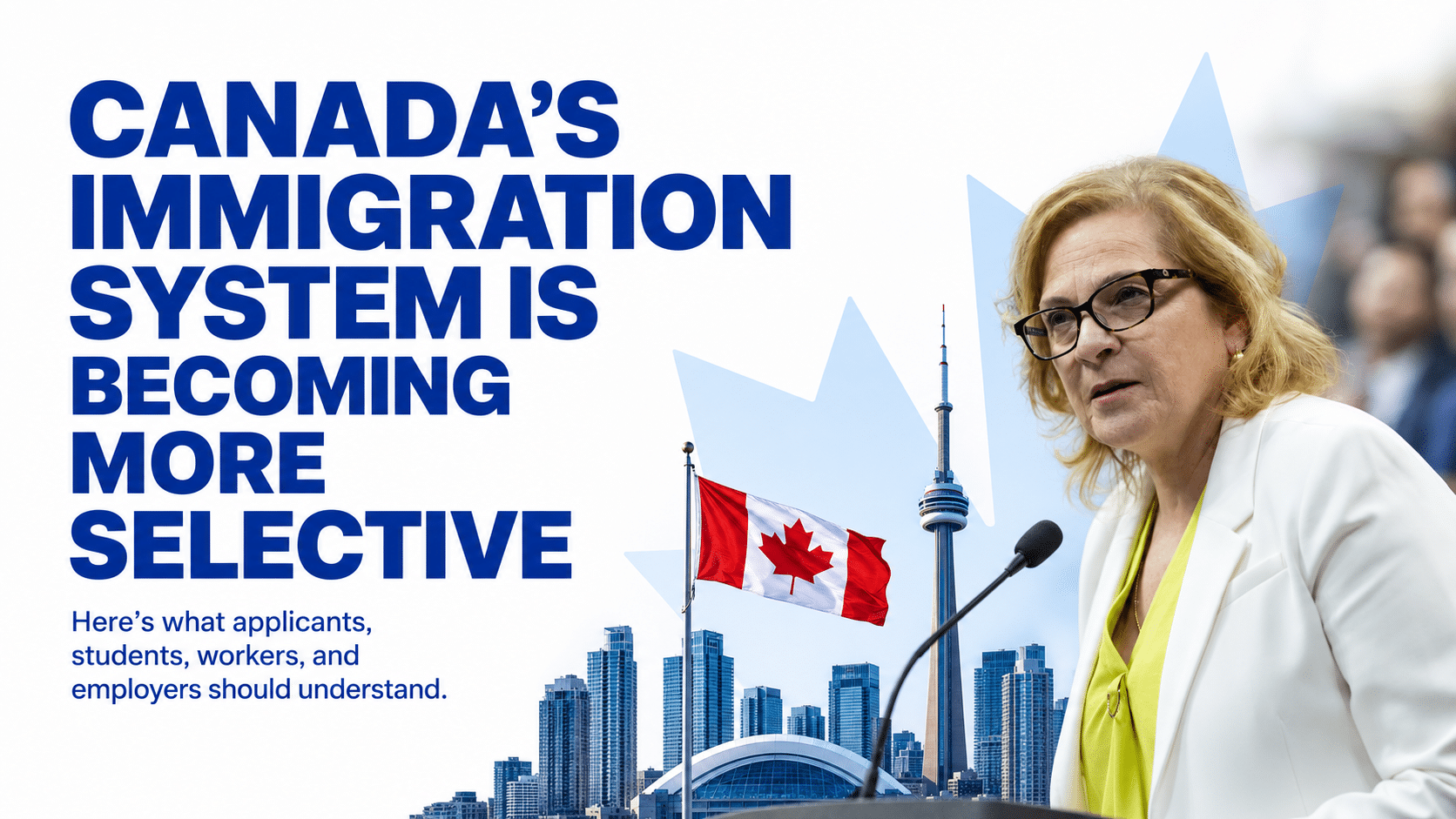
In Lena Diab’s first year as immigration minister, the better question became more revealing: Who gets prioritized, where, and through which pathway? The answer is a system that looks less broad, less one-size-fits-all, and much more selective in how it chooses people, processes applications, and manages risk.
That is what makes Diab’s first year so important. The story is not just about tighter rules or lower pressure. It is about a new design philosophy. The source material points to three big patterns: more targeted permanent residence selection, more streamlined temporary residence administration, and stricter asylum controls. Parliament and IRCC’s own Bill C-12 materials reinforce that this shift is not rhetorical. It is now embedded in law and policy.

Why Canada’s immigration story feels different now
The easiest way to understand Diab’s first year is this: Canada’s immigration system is becoming more precise. Instead of relying as heavily on broad national selection, the system is increasingly rewarding the right applicant in the right region, in the right occupation, at the right time.
That matters because it changes how applicants should think. A decent overall profile may no longer be enough on its own. Provincial fit, rural work history, occupation-specific demand, and existing presence in Canada seem to matter more than before. In other words, the system now looks less like one wide door and more like several narrower, better-defined lanes.
The biggest changes to permanent residence, permits, and asylum
Permanent residence is becoming more regional.
One of the clearest signals in the source content is the growing role of provinces in economic immigration. The file says provincial allocations for permanent residence selection rose to 91,500 for 2026, up from 55,000 in the previous plan, while the federal high-level allocation dropped to 109,000 from 124,680. That suggests a deliberate move away from a more centralized model and toward regional labour-market targeting. British Columbia’s focus on healthcare workers, tradespeople, entrepreneurs, and other high-impact candidates is a good example of how this approach works in practice in Canada’s Immigration.
Rural Canada is no longer a side note.
The rural push is not just symbolic. The file describes an “In-Canada Workers Initiative” aimed at transitioning 33,000 temporary workers in smaller communities to permanent residence across 2026 and 2027.
The first details released in May 2026 said that at least two years of living in a smaller community would be required, and part of the plan involves accelerating eligible files already sitting in existing inventories. The same source also notes temporary TFWP measures that let eligible rural employers in several provinces fill up to 15% of their workforce through the low-wage stream, up from the standard 10% limit, from April 1, 2026, to March 31, 2027. Together, those moves show that rural labour shortages are now shaping immigration design much more directly.
Express Entry is becoming more surgical.
Under Diab, the file says IRCC introduced five narrow category-based selection streams: physicians with Canadian work experience, senior managers with Canadian work experience, researchers with Canadian work experience, transport, and skilled military recruits.
These are far smaller and more targeted than older broad categories such as trades, STEM, or healthcare. The source also says the work-experience requirement for category-based selection rose to one year of non-continuous experience, replacing the older six months of continuous experience standard. That means category-based selection can now reward very specific talent while asking more from candidates who want to qualify for it.
The scale difference matters. The source notes that newer niche draws invited only 250 senior managers and 391 physicians, while Canadian Experience Class draws in 2026 ranged from 2,000 to 8,000 invitations. That comparison tells readers something important: the future of Express Entry may not be wider draws for everyone, but smaller, more intentional invitations for selected groups.
Not every rule got tougher. Some got simpler.
Diab’s first year also brought a more streamlined approach to temporary residence administration. According to the source file, master’s and doctoral students no longer need a provincial or territorial attestation letter; doctoral study permits can be processed in as little as two weeks, post-secondary students in co-ops, internships, and practicums no longer need a separate co-op work permit, and WP-EXT letters for people on maintained status now last 365 days instead of 180. Public reporting in April 2026 also reflected the removal of the separate co-op permit requirement and the extension of WP-EXT validity.
This is a useful contrast. Canada is not simply making immigration “harder” across the board. It is removing friction where the government sees unnecessary administration, especially for people already in the system, while tightening control in other areas. That is a more nuanced story than a simple crackdown narrative.
The asylum system became significantly stricter.
Parliament’s LEGIS info page shows that Bill C-12 received royal assent on March 26, 2026, and IRCC says the law brought changes in four key areas: asylum eligibility, asylum process modernization, domestic information sharing, and immigration-document/application authorities.
IRCC’s backgrounder states that asylum claims made more than one year after a person’s first entry into Canada after June 24, 2020, as well as certain claims made more than 14 days after irregular entry across the Canada–US land border, will not be referred to the Immigration and Refugee Board. IRCC also says the law now gives the government tools to cancel, suspend, or change large groups of immigration documents, pause intake, or suspend processing in the public interest, subject to the Governor in Council approval.
That is one of the clearest dividing lines in Diab’s first year. On the one hand, some student and worker processes were simplified. On the other hand, Canada’s asylum framework and document-management powers became more restrictive and more centralized in how they can be used. The result is a system that feels more controlled, more selective, and more state-directed than before.
More change could still be coming.
The file also says IRCC is consulting on an overhaul of Express Entry through its Forward Regulatory Plan, including replacing the three existing Express Entry programs with one streamlined program and reshaping the Comprehensive Ranking System to reward high-wage occupations more strongly, bring back job-offer points for high-wage workers, and better recognize trade qualifications. Public reporting in April 2026 also described those proposed reforms as a major restructuring rather than a finalized rule change. That distinction matters: the direction is visible, but the details are not yet settled.
What these shifts mean for applicants
For permanent residence hopefuls, the biggest lesson is simple: general eligibility is not the same as strategic fit. A decent CRS score or broad work history may still help, but the stronger advantage now appears to go to candidates who fit a province’s labour needs, belong to a narrowly targeted occupation group, or already have roots in Canada outside its largest urban centers.
For international students, the system looks slightly less bureaucratic in a few places but more intentional overall. Some barriers have been removed, especially around attestation letters, co-op permits, and proof of continued work authorization. But those improvements sit alongside a wider policy environment that is clearly trying to align study and work pathways more tightly with labour-market outcomes and program control.
For employers, especially in rural communities, immigration policy is becoming a sharper workforce tool. If a business can show a real local shortage and align with a province’s priorities, the system increasingly appears designed to support that match. For people planning their immigration to Canada, that means geography matters more than many applicants used to assume.
Practical takeaways
- Start with province, region, and occupation, not just the federal pool.
- If you may qualify under a niche Express Entry category, make your work history evidence exceptionally clean and specific.
- Students and current workers should double-check whether recent process simplifications apply to their exact permit type before filing anything.
- Treat proposed Express Entry reforms as directional, not final, until consultations turn into formal rules.
Need Help Understanding What These Canada Immigration Changes Mean for You?
Canada’s immigration system is changing quickly, and policy updates can affect different applicants in different ways. A change that helps one applicant may create new challenges for another, especially when it comes to Express Entry, study permits, work permits, rural immigration pathways, or permanent residence planning.
That is where professional guidance can make a difference.
AMK Global helps individuals, students, workers, families, and employers understand their Canadian immigration options with more clarity. Whether you are planning to study in Canada, apply for a work permit, explore permanent residence, or understand how recent IRCC changes may affect your eligibility, AMK Global can help you take the next step with confidence.
Instead of trying to decode every policy update on your own, you can get personalized support based on your profile, goals, and timeline.
Speak with AMK Global today to understand your best pathway to Canada and make informed immigration decisions.
Have questions about your eligibility or next steps? Mail us at apply@amk.global or visit our Contact Us page to connect with the AMK Global team.
FAQ
What is the biggest immigration shift under Lena Diab?
The biggest shift is not just lower or higher numbers. It is a move toward targeted selection: more provincial influence, more rural prioritization, narrower Express Entry categories, and tougher asylum rules.
Did Express Entry become easier or harder?
It became more favourable for certain candidates and less forgiving for others. If you match a priority occupation or category, you may benefit from more focused selection. If you do not, the system may feel harder because categories are narrower and the work-experience threshold for category-based selection increases.
Are study and work permits easier now?
In some cases, yes. The file says master’s and doctoral students no longer need PAL/TAL documents, doctoral permits can move faster, post-secondary students no longer need separate co-op permits for qualifying placements, and WP-EXT letters now last 365 days. But those changes are best understood as administrative streamlining, not a broad opening of the system.
Did Bill C-12 only affect asylum claims?
No. IRCC says Bill C-12 changed asylum eligibility and process rules, but it also created new domestic information-sharing authorities and new powers over large groups of immigration documents and applications when the government says the public interest requires it.
Are the proposed Express Entry reforms already in force?
Not based on the source material. The proposed merger of the three current Express Entry programs into one streamlined pathway, along with possible CRS changes, was still under consultation in spring 2026.
What’s the Conclusion?
After one year under Lena Diab, Canada’s immigration system looks less like a giant funnel and more like a carefully managed set of channels. Provinces have a bigger voice. Rural employers and communities matter more. Express Entry is becoming narrower and more targeted. Student and worker administration is being simplified in selected areas. And asylum rules are clearly tougher than before.