
Table of Contents
7 Steps for Moving from Morocco to Canada
Moving from Morocco to Canada is an important goal for many Moroccan professionals, students and families seeking better career opportunities, quality education and long-term settlement options. Canada’s French- and English-speaking communities may be especially attractive to applicants who speak French, English or both languages.
However, moving to Canada is not easy or guaranteed. Every applicant must qualify under a specific immigration, study or work pathway based on their education, work experience, language ability, finances and personal circumstances.
Immigration Pathways from Morocco to Canada
Applicants planning to move from Morocco to Canada may explore several immigration programs. The most suitable option depends on the applicant’s qualifications, professional background, language-test results and preferred Canadian destination.
Express Entry
Express Entry manages applications under federal economic immigration programs, including the Federal Skilled Worker Program and Canadian Experience Class.
Candidates are ranked through the Comprehensive Ranking System. Points may be awarded for age, education, skilled work experience, English or French ability and other profile factors.
Applicants with qualifications obtained outside Canada may need an Educational Credential Assessment. They may also require valid language results, employment reference letters, police certificates, proof of settlement funds and other supporting documents.
Being eligible to enter the Express Entry pool does not guarantee an invitation to apply for Canadian permanent residence.
Provincial and Quebec Immigration Programs
Canadian provinces and territories operate Provincial Nominee Programs to address regional labour-market needs. Eligibility differs by province, and some pathways may require a job offer, work experience in a selected occupation or an existing connection to the province.
Quebec manages separate selection programs for many economic immigrants. Applicants considering a move from Morocco to Canada who intend to settle in Quebec should review Quebec-specific immigration requirements instead of relying only on federal program information.
How French Can Improve Your Opportunities
French-language ability can provide important immigration and employment advantages inside and outside Quebec.
Eligible Express Entry candidates may receive additional Comprehensive Ranking System points for strong French results. French-language proficiency may also be considered in category-based Express Entry invitation rounds when included under current Immigration, Refugees and Citizenship Canada rules.
IRCC-approved French tests: Approved French tests for federal immigration include TEF Canada and TCF Canada. Approved English tests include IELTS General Training and CELPIP-General.
Applicants who demonstrate both French and English ability may have broader opportunities in bilingual workplaces, government services, education, finance, technology, tourism, healthcare and customer service.
Language ability alone does not guarantee immigration approval. Test scores must meet the requirements of the selected program and remain valid when the application is submitted.
Francophone Mobility Work Permit
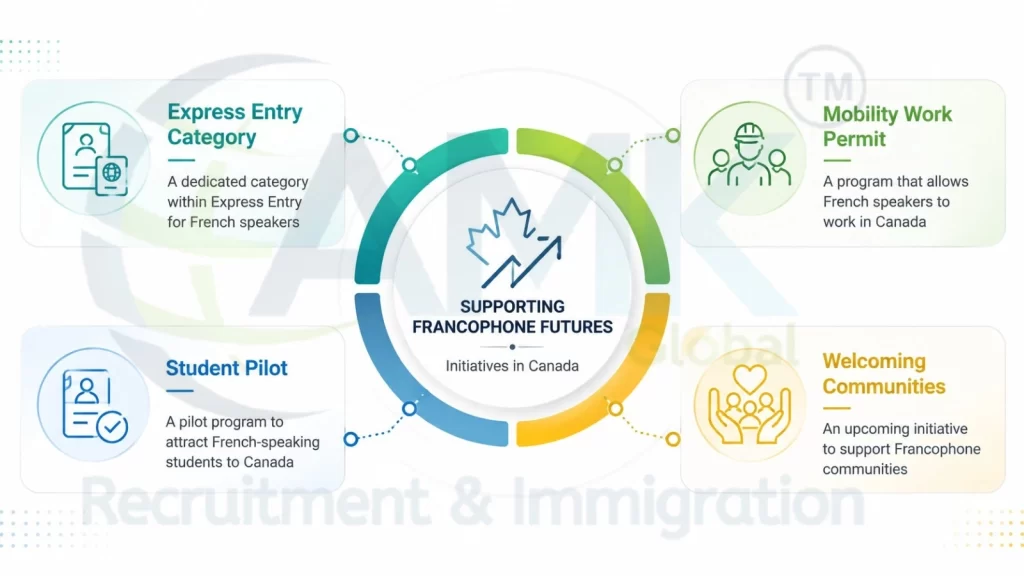
The Francophone Mobility work permit may offer another pathway for eligible French-speaking applicants moving from Morocco to Canada for employment.
This employer-specific work permit allows eligible French-speaking foreign nationals to work for qualifying employers outside Quebec. An applicant generally requires a genuine job offer for a position outside Quebec and must demonstrate the level of French speaking and listening ability required under the current rules.
The employer normally completes the employer-side process through the Employer Portal, pays the employer compliance fee and gives the worker an offer-of-employment number. A Labour Market Impact Assessment is generally not required when all Francophone Mobility conditions are satisfied.
The worker then submits a work permit application with documents such as:
- A valid passport
- A genuine employment offer
- Evidence of French-language ability
- Education or professional qualifications
- Work experience documents
- Biometrics, when required
- Medical examination results, when required
Francophone Mobility is a temporary work permit rather than a permanent residence program. Eligible Canadian work experience may support a future permanent residence strategy, but it does not guarantee PR. Check Francophone Mobility work permit requirements.
Studying in Canada from Morocco
Moroccan students must generally receive admission from a designated learning institution before applying for a study permit.
Depending on the institution, province and current immigration rules, applicants may also need proof of financial support and a provincial or territorial attestation letter. Students planning to study in Quebec may require a Quebec Acceptance Certificate.
Before paying tuition, students should confirm whether the institution and chosen study program may qualify for a post-graduation work permit. Completing a Canadian program does not automatically guarantee a work permit or permanent residence.
Students using education as part of their Morocco to Canada journey should also consider tuition costs, accommodation, transportation, health coverage and other living expenses.
Finding a Genuine Canadian Job
Applicants searching for employment from Morocco should prepare a Canadian-style résumé, maintain a professional LinkedIn profile and apply through legitimate job platforms or verified employer websites.
French-speaking applicants may target bilingual employers and Francophone communities outside Quebec. Some eligible employers may also be able to hire workers through the Francophone Mobility work permit process.
Never pay an employer for a Canadian job offer, recruitment promise or Labour Market Impact Assessment. Verify the company, job duties, email address, contact information and employment contract before sharing personal documents.
Protect yourself from Canadian immigration fraud.
Documents and Costs to Prepare
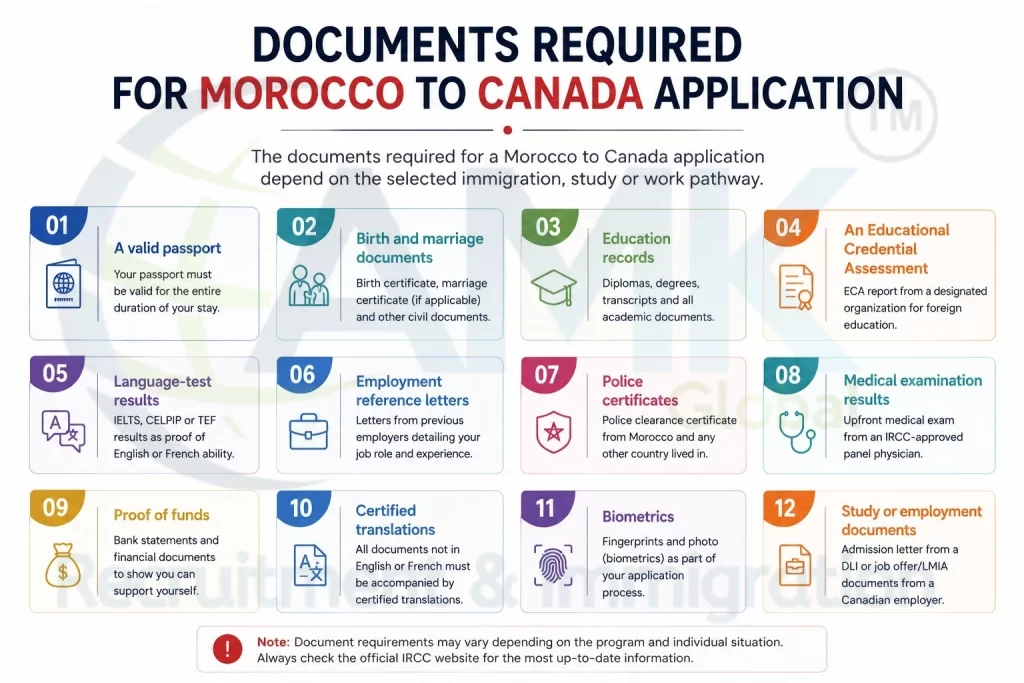
The documents required for a Morocco to Canada application depend on the selected immigration, study or work pathway. Applicants may need:
- A valid passport
- Birth and marriage documents
- Education records
- An Educational Credential Assessment
- Language-test results
- Employment reference letters
- Police certificates
- Medical examination results
- Proof of funds
- Certified translations
- Biometrics
- Study or employment documents
Applicants should also budget for government application fees, language tests, educational assessments, document translations, medical examinations, travel and initial settlement expenses.
Fees, financial requirements and immigration policies may change. Applicants should always confirm current information through official Canadian government websites.
Check Your Eligibility with AMK Global Group
Selecting the right pathway from Morocco to Canada can be difficult because immigration eligibility depends on the applicant’s complete personal profile.
AMK Global Group supports individuals and families who want to explore options for studying, working or settling in Canada. Our team can help you understand pathways such as Express Entry, Provincial Nominee Programs, Quebec immigration, study permits and the Francophone Mobility work permit.
Complete our eligibility assessment form to provide details about your age, education, work experience, language ability, finances and immigration goals.
After reviewing your information, the AMK Global Group team can contact you to discuss pathways that may be relevant to your circumstances. You may also book a consultation for a more detailed profile assessment.
Submitting the form does not guarantee eligibility, employment, a visa or permanent residence. Recommendations depend on your complete profile and the immigration rules in effect at the time of assessment.
Disclaimer: Canadian immigration programs, eligibility requirements, fees and policies may change. This article provides general information and is not legal advice. Always verify current requirements through official government sources or consult an authorized Canadian immigration professional.
Frequently Asked Questions (FAQ)
1. Can a Moroccan citizen move from Morocco to Canada?
Yes. Moroccan citizens may apply through Canadian immigration, work or study pathways if they meet the requirements of the specific program. Options may include Express Entry, Provincial Nominee Programs, Quebec immigration programs, study permits and employer-supported work permits.
2. What is the best way to move from Morocco to Canada?
There is no single best pathway for everyone. The most suitable option depends on factors such as age, education, skilled work experience, language ability, finances, job offers and where you intend to live in Canada. Express Entry is one important pathway for skilled workers, while Quebec operates separate selection programs for many economic immigrants.
3. Is French enough to immigrate from Morocco to Canada?
French can significantly strengthen some immigration profiles, but speaking French alone does not guarantee eligibility or permanent residence. Applicants must still satisfy the requirements of the immigration program they are applying through. Express Entry applicants must provide results from an IRCC-approved language test even if French is their native language.
4. Which French language tests are accepted for Canadian immigration?
For Express Entry, IRCC accepts approved French tests including TEF Canada and TCF Canada. Applicants must submit valid test results and meet the language level required by their particular immigration program.
5. What is the Francophone Mobility work permit?
Francophone Mobility is an LMIA-exempt, employer-specific work permit pathway designed to help eligible French-speaking foreign nationals work in communities outside Quebec. Applicants must meet current language, job-offer and work-permit requirements.
6. Do I need an LMIA for Francophone Mobility?
Generally, no. If all Francophone Mobility requirements are met, the employer can use LMIA exemption code C16. The employer must complete the applicable Employer Portal process before the worker applies for the work permit.
7. Can I use Francophone Mobility to work in Quebec?
No. Francophone Mobility is intended for eligible employment outside Quebec. Applicants who want to work or settle in Quebec should explore Quebec-specific immigration and temporary worker pathways.
8. Can a Francophone Mobility work permit lead to permanent residence?
Francophone Mobility itself is a temporary work permit and does not provide permanent residence automatically. However, eligible Canadian work experience may later contribute to a separate permanent residence strategy, depending on the applicant’s circumstances and the immigration rules in effect at that time.
9. Can Moroccan students study in Canada?
Yes. Moroccan citizens may apply for a Canadian study permit after meeting applicable admission and immigration requirements. Students should carefully verify their institution, study program and current permit requirements before applying and should not assume that studying in Canada guarantees permanent residence.
10. Is Quebec a good option for French-speaking Moroccans?
Quebec may be attractive to French-speaking applicants because French is the province’s official and common language. However, Quebec operates its own immigration selection system for many economic programs, so applicants should compare Quebec requirements with federal and provincial options elsewhere in Canada.
11. Do I need a language test for Express Entry if I already speak French?
Yes. Express Entry applicants must provide results from an approved language test. IRCC applies the same language-testing standards regardless of an applicant’s nationality or whether French or English is their native language.
12. Can I move from Morocco to Canada without a job offer?
Potentially. Some immigration pathways do not always require a Canadian job offer, while others may require or strongly depend on one. Express Entry eligibility and ranking involve several factors, so applicants should assess the requirements of the specific program rather than assuming a job offer is mandatory in every case.
13. How much money do I need to move from Morocco to Canada?
The amount varies by pathway and family size. Applicants may need to budget for government fees, language testing, credential assessments, biometrics, medical examinations, travel and settlement expenses. Some permanent residence programs also require proof of settlement funds. Applicants should verify the latest amounts directly through IRCC before applying.
14. How can I avoid Canada immigration scams?
Do not rely on guaranteed visa claims, fake job offers or unauthorized representatives. If you pay someone to represent you in a Canadian immigration application, verify that they are legally authorized to provide paid immigration services. IRCC provides official tools to check representatives and guidance on identifying fraud.
15. How can I check my eligibility to move from Morocco to Canada?
Eligibility depends on your individual profile, including your age, education, work experience, language ability, family circumstances and immigration goals. You can complete the AMK Global Group eligibility assessment form to provide your details and explore pathways that may be relevant to your profile.
Check Your Eligibility
Submitting an assessment does not guarantee a visa, work permit, permanent residence or immigration approval.


Leave a Comment